Managing ten API keys, ten billing dashboards, and ten pricing tiers is not a rite of passage — it is friction that quietly burns engineering time. You start with one text model, then add image generation for user avatars, then someone wants a video clip, and before you know it your .env file stares back at you like a spreadsheet. This is the problem the "one API key for all models" pitch is supposed to fix. But most platforms stop at text — and that leaves half the problem unsolved.
Why "One Key, All Models" Is Suddenly Everywhere
The unified API gateway has become one of the hottest developer-tool categories of 2025-2026. The pitch is straightforward: stop juggling separate API keys for OpenAI, Anthropic, DeepSeek, and every other provider. One endpoint, one billing account, one integration to maintain.
The demand is real. Developers building AI-powered products routinely deal with:
- Multiple billing relationships: each provider wants its own account, its own top-up, its own invoice cycle.
- Protocol churn: every few months, a provider deprecates an endpoint or changes a parameter name, and you patch your integration again.
- Key rotation fatigue: rotate keys across five or six dashboards, and one always gets missed.
Several platforms now compete on this promise, with model counts in the 250+ range. On paper, it sounds like the problem is solved. In practice, there is a blind spot large enough to matter.
The Blind Spot of Most Unified API Platforms
The platforms that dominate the "one key for everything" conversation have a specific shape: they aggregate text models — and text models only. If you are building a chatbot, a coding assistant, or a document processor, that is plenty. But if your product touches anything visual, auditory, or multimodal, you are back to square one.
Consider a product that generates marketing assets for e-commerce stores. It needs:
- A text model to write product descriptions and ad copy
- An image model to generate product photos and lifestyle shots
- Possibly a video model to create short social-media clips from those images
On a text-only unified platform, you solve item one. For items two and three, you open new accounts elsewhere, manage separate billing, and write separate integrations. The "one key" promise breaks at the boundary of text. You still end up with a fragmented stack — just one fewer fragment than before.
This boundary exists because image, video, audio, and music generation operate on fundamentally different infrastructure from text models. They use different GPU profiles, different serving patterns (often async task queues rather than streaming responses), and different pricing dimensions (per-image rather than per-token). Building a gateway that handles both is significantly more engineering work. Most aggregators chose not to.
What Makes HiAPI Different: Beyond Text Aggregation
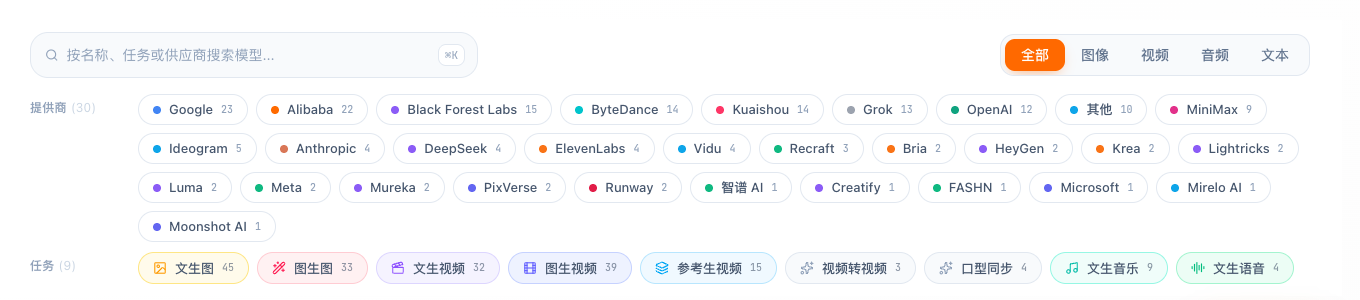
HiAPI covers 182 models (as of October 2026) across every major modality. One API key, one balance, one protocol family — and it does not stop at text.
| Category | Models | Subcategories |
|---|---|---|
| Text | 17 | Chat Completions (9) + Responses (8) |
| Image | 69 | Text-to-image (46), image-to-image (23) |
| Video | 70 | Text-to-video (30), image-to-video (29), reference-to-video (9), motion-control (1), transformation (1) |
| Audio | 9 | Text-to-speech (4), text-to-audio (2), and others |
| Music | 4 | Text-to-music |
| Other | 13 | — |
The practical implication: you can build a product that generates text, images, video, audio, and music — all through a single integration, pulling from a single prepaid balance. No separate billing accounts. No per-modality top-ups. No cobbled-together API surface from four different providers.
For text, HiAPI supports three protocols:
- OpenAI Chat Completions (
/v1/chat/completions) — the most widely adopted format - Anthropic Messages (
/v1/messages) — native format for Anthropic models - OpenAI Responses (
/v1/responses) — the newer stateful protocol
For image, video, audio, and music, the platform uses an async task API (/v1/tasks): submit a job, poll for completion, retrieve the result. This pattern handles generation workloads that take seconds to minutes rather than milliseconds.
Model Selection by Use Case
Having 17 text models is useful; knowing which one to pick for a given job is what saves time. Here is a practical guide organized by what you are actually building.
Batch Processing and Data Extraction
If you are running large-scale classification, extraction, or summarization pipelines, cost-per-token dominates your economics. The sweet spot here is GPT-5.6 Luna at $0.05 per million input tokens and $0.30 per million output tokens. At this price tier, processing millions of documents becomes viable without blowing the compute budget.
For vision-aware batch work, DeepSeek V4 Flash Vision ($0.29/$0.86) handles image inputs at a fraction of the cost of larger vision models.
Daily Coding and Development
For coding workflows — autocomplete, refactoring, test generation — you need fast response times and strong instruction-following. Two models stand out:
- DeepSeek V4 Pro at $1.50/$4.50 per million tokens: strong coding performance at a moderate price.
- Claude Sonnet 4.6 at $3.00/$15.00 per million tokens: higher cost, but the go-to choice for complex codebases and long-context reasoning.
Most teams pair these: Sonnet for architecture and tricky debugging, DeepSeek for routine tasks and volume.
Complex Reasoning and Research
When the task demands multi-step reasoning, deep analysis, or adversarial evaluation, you reach for the flagships:
- Claude Opus 5.5 ($2.02/$10.08): best-in-class for nuanced analysis, legal reasoning, and tasks where correctness is non-negotiable.
- GPT-5.6 Sol ($1.25/$7.50): strong all-around reasoning with a price advantage over comparable Anthropic models.
Both support the full set of HiAPI protocols, so switching between them is a one-line change in your client configuration.
Image and Video Generation
This is where HiAPI diverges from text-only aggregators. Among 69 image models and 70 video models, the selection depends on your output requirements — photorealism, stylization, text rendering accuracy, or motion quality. The async task API is consistent across all of them: the request shape does not change when you switch models.
How Hard Is It to Switch from Another Platform
If your code already uses the OpenAI Chat Completions format, the migration is two changes: base_url and api_key. That is it. No client library swap, no message format rewrite, no parameter remapping.
# Before: direct OpenAI-compatible call
client = OpenAI(
    base_url="https://api.other-platform.com/v1",
    api_key="sk-old-key"
)

# After: HiAPI with the same code
client = OpenAI(
    base_url="https://api.hiapi.ai/v1",
    api_key="sk-hiapi-key"
)
The same pattern works in JavaScript, curl, or any language with an OpenAI client library. If your code targets the Anthropic Messages protocol directly, HiAPI speaks that too — swap the base URL and you are done.
The migration surface gets slightly larger if you were also using separate integrations for image and video generation. But that is the point: those now collapse into a single platform with one key, one balance, and one integration to maintain. You delete code, not add it.
FAQ
Does HiAPI only do text models?
No. HiAPI covers 182 models across text (17), image (69), video (70), audio (9), and music (4). It is the modality coverage — not just the model count — that sets it apart from text-only aggregators.
What API protocols are supported?
For text: OpenAI Chat Completions, OpenAI Responses, and Anthropic Messages. For image, video, audio, and music: an async task API (/v1/tasks) that handles long-running generation jobs.
How does pricing work across modalities?
A single prepaid balance covers everything. Text models bill per million tokens (input and output at different rates). Image, video, audio, and music models bill per generation task, with pricing visible per model. You top up once and all modalities draw from the same pool.
Is it really just changing the base URL?
For OpenAI-compatible code, yes. Change base_url to https://api.hiapi.ai/v1 and api_key to your HiAPI key. No client library changes, no message format migration. The same applies to code using the Anthropic Messages protocol directly.
Can I use one key for everything including image and video generation?
Yes. The same API key authenticates requests to text models (via Chat Completions / Messages / Responses endpoints), image models, video models, audio models, and music models (via the async task endpoint). One key governs the entire platform.
What is the cheapest text model available?
GPT-5.6 Luna at $0.05 per million input tokens and $0.30 per million output tokens. It is suitable for batch processing, classification, and extraction where volume matters more than peak reasoning quality.
How many text models can I choose from?
Seventeen text models spanning budget ($0.05/M input) to flagship ($5.74/M input at the high end), from OpenAI, Anthropic, DeepSeek, xAI, Moonshot AI, and Zhipu. Most speak OpenAI Chat Completions, and eight additionally expose the Responses protocol; the Claude models also support the native Anthropic Messages protocol.
If you already use an OpenAI-compatible client, switching to HiAPI takes two changes: base_url and api_key. To compare models without writing code, try the Playground.