The striking part of this two-minute Made of Everything film is not any one pretty frame. It starts with one idea, then Claude Opus 5.5 carries the work through lyrics, storyboard, frame-by-frame drawing, and rendering tasks. MiniMax Music 2.6 generates the song; scripts align beats and subtitles; the result is a hand-painted music video with sound.
This is a connected agent workflow. Opus 5.5 turns an abstract idea into lyrics, executable shots, and drawing code. MiniMax Music 2.6 turns the lyric and style prompt into a song, and scripts assemble music, animation, and subtitles into one film. The creator still reviews two high-leverage checkpoints: the storyboard and the lyrics.
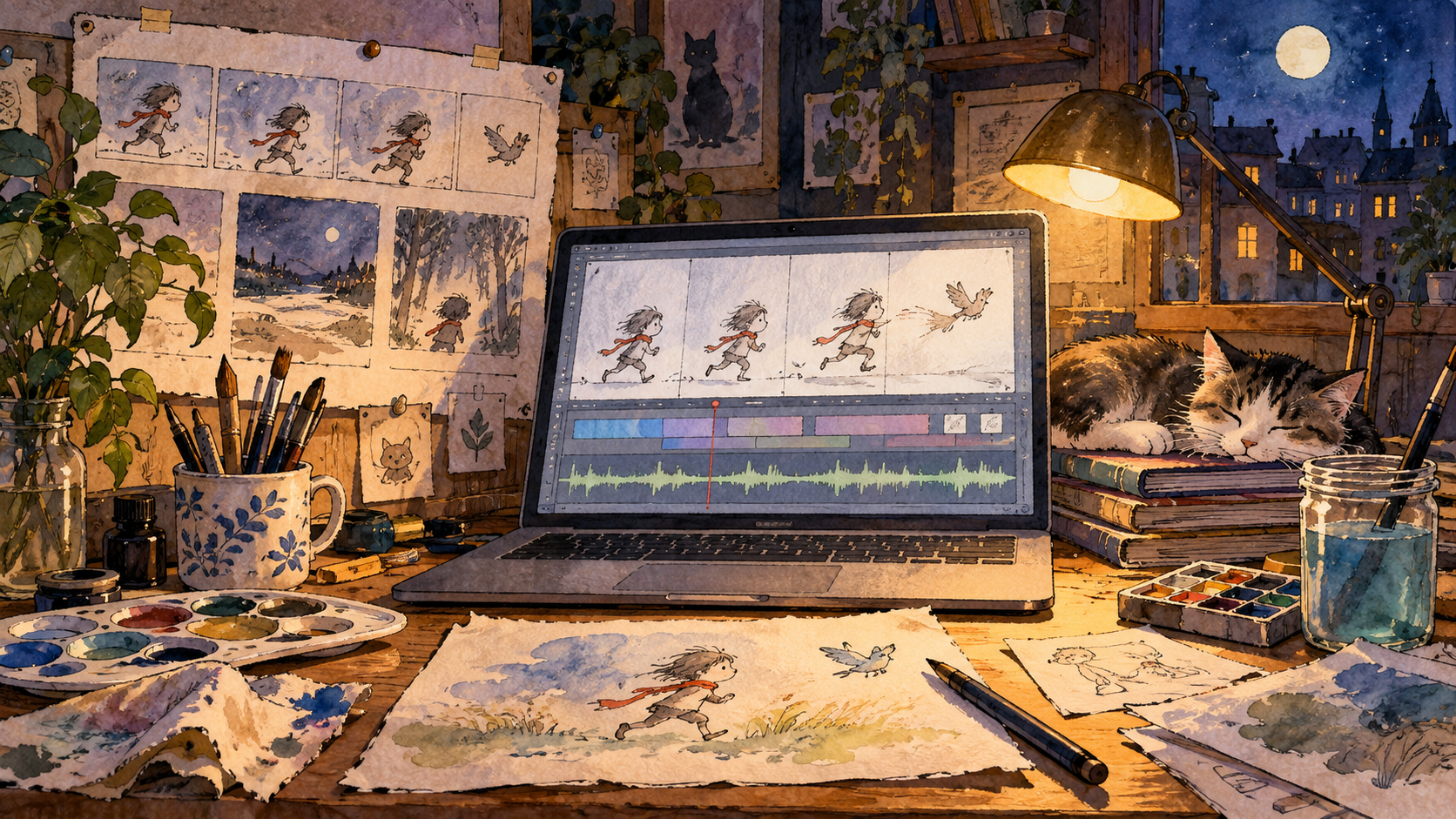
This cover is an illustration of the workflow, not a screenshot from either repository film.
Watch the real films and inspect the source material
The public Skill repository includes two finished films, their storyboards, and timed lyrics. Watching a film before reading the workflow makes it easier to decide whether the approach suits your own subject.
Made of Everything, 2:37
Just One More Prompt, 2:26
These are the original films and production material from the repository, not images generated for this article.
The visuals are drawn in code, not generated as images
The hand-painted scenes are not handed directly to a text-to-image or text-to-video model. The Skill asks a coding agent to draw each frame in code, then render them into continuous shots.
The visual engine uses p5.brush: flat colour, watercolour washes, and ink outlines. Lines redraw with small variation, a paper texture sits over the whole frame, and the look stays 2D, without 3D or text inside the image. The underlying engine and craft guide come from ClaudeAnimationBase.
That makes the storyboard and the code the main control surface. Character movement, cuts, and when an object enters the frame can all be decided in the shot script. For a longer film that needs one coherent look, this is easier to keep consistent than treating every shot as a separate generation.
Lyrics, music, timing, and visuals are separate jobs
The API-key-dependent work is lyric writing and music generation. The Skill uses Claude Opus 5.5 to expand an idea into lyrics and a music-style prompt, then uses MiniMax Music 2.6 to generate a sung song. It can generate several takes in parallel so the creator can choose the one that best fits the storyboard.
When the music is selected, align.py finds the tempo, first beat, and lyric-line timing. The animation engine uses that timing to place movement and subtitles. assemble.sh renders the frames, combines the audio, burns subtitles, and exports an MP4.
The workflow is: one idea → lyrics and style → song generation → beat and lyric alignment → code-drawn shots → audio and subtitle assembly. Sound runs through HiAPI while visual animation runs through code, with inspectable output at each stage.
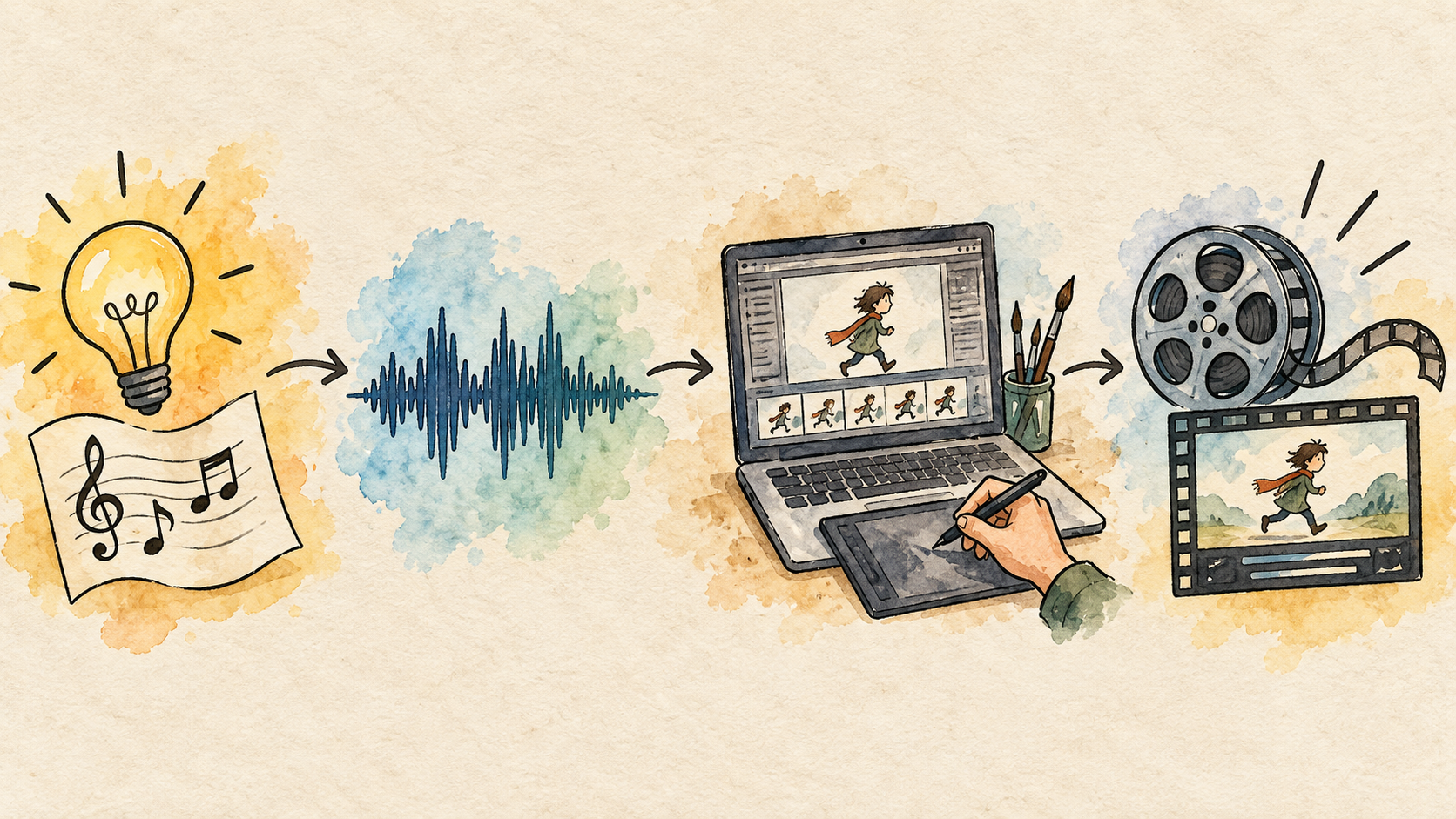
An illustration of the path from idea and music to code-drawn scenes and a finished film.
What you actually receive
A finished project is more than an MP4. It includes the storyboard, lyric and style prompts, song takes, timed lyrics, rendered shots, and the final subtitled film. Those intermediate assets mean you can change a lyric, swap a song, redraw one shot, or revise subtitles without starting the whole project again.
How the workflow became a Skill
The Skill does not receive one sentence and silently produce a full film. It first agrees the subject and duration, then shows the storyboard. Before a song is generated, it shows the lyrics for approval. During production it works scene by scene and checks contact sheets. The final output is an MP4; the Skill never publishes it on its own.
The public repository is HiAPIAI/hiapi-hand-painted-animation-skill. Install it with:
npx -y github:HiAPIAI/hiapi-hand-painted-animation-skill -y
export HIAPI_API_KEY=your_key
HIAPI_API_KEY is only needed for lyric writing and song generation. A hand-painted silent short without music or dialogue can skip that configuration.
What you need locally
The local workflow needs Node 18+, ffmpeg, uv, git, and Google Chrome or Chromium. The repository includes setup-animation.sh to prepare a project, write-lyrics.mjs to turn an idea into lyrics and a style prompt, make-song.mjs to create several song takes, align.py to align beat and lyrics, and assemble.sh to render, combine audio, and burn subtitles.
For a first run, reproduce one of the repository examples. Once your machine reliably exports an MP4, replace the sample idea with your own. That makes it easier to separate an environment issue from a music-generation problem or a scene that needs code changes.
Subjects that fit this approach
The workflow works especially well for stories, explainers, and short brand films. You can turn CPU cache behavior into a one-minute cartoon, make a short song for a product launch, or create an anniversary film with a recurring character and a stable visual language.
It is less suited to photorealistic people, complex 3D shots, or immediate high-volume ad variants. The benefit of the hand-painted direction is a consistent, controllable authored look. The trade-off is that each shot needs a storyboard and rendering time.
License and next step
The Skill is MIT licensed, and ClaudeAnimationBase is MIT licensed as well. The repository examples and production structure are useful starting points, while a new production should still clear its own lyrics, music, people, and brand assets.
Start with a 30 to 60 second idea, give it to the agent, and use the storyboard to turn it into a finished film one shot at a time.