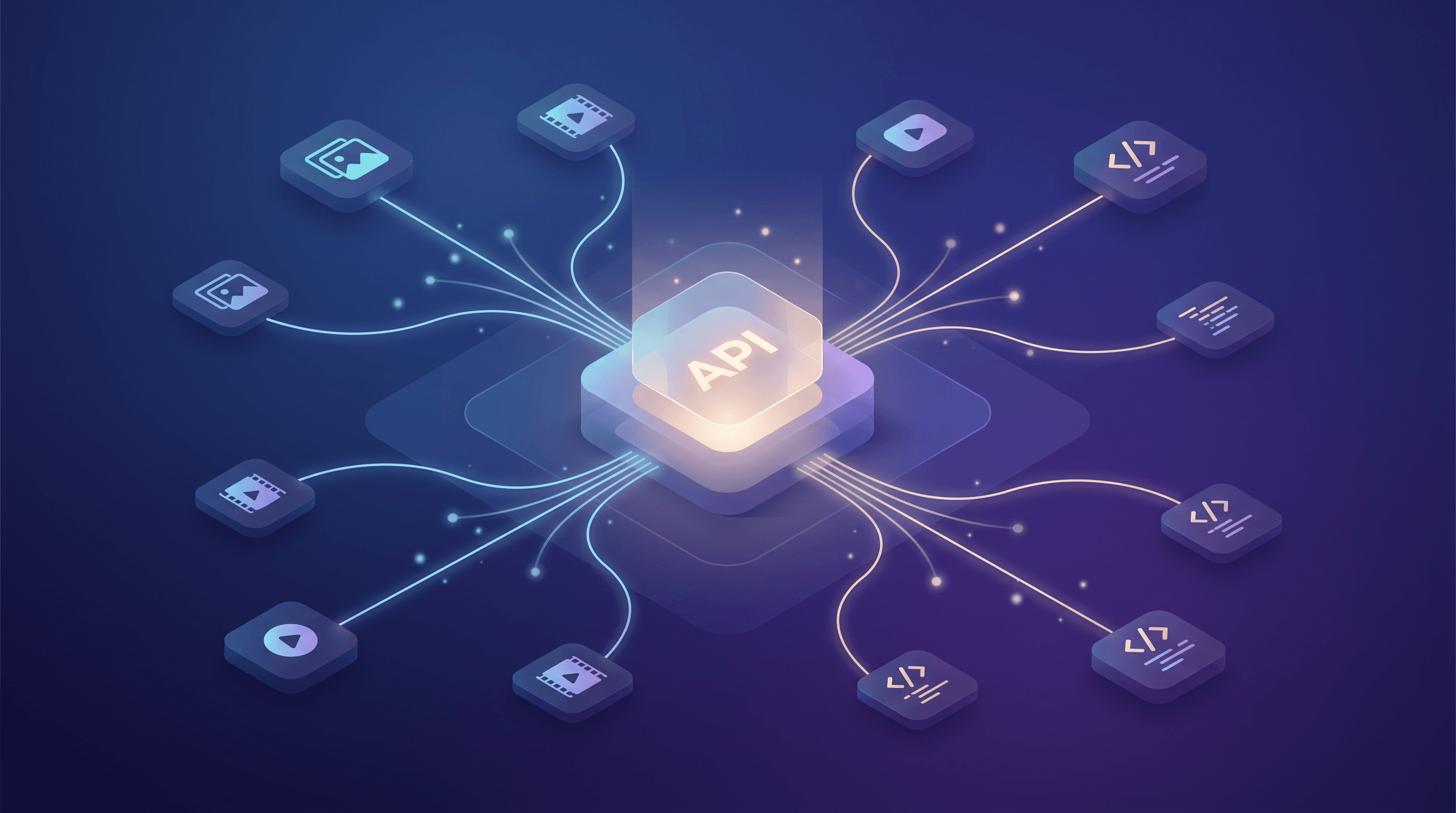
KIE.ai is one of several platforms developers consider when they want a single API key for a changing mix of AI models. The practical question is not which catalog has the biggest number on a landing page. It is whether a provider supports the models, protocol, languages, and operating pattern your product needs today.
This guide compares five reasonable places to start. Catalogs, prices, and model availability move quickly, so treat this as a shortlist for technical evaluation, then verify the exact model and price in each provider's current documentation.
What to compare before moving a workload
For media generation, check the full request lifecycle: creating a task, submitting references, receiving completion, downloading assets, and handling a failed task. For text models, also check whether your client can keep its OpenAI-style request shape or needs an adapter. A provider that looks cheaper for one model can still cost more engineering time if it changes your queue, callbacks, or storage flow.
HiAPI for a unified media API and agent workflows
HiAPI groups image, video, audio, and supported text models behind one account. Media generation uses a unified asynchronous task flow, while supported text models can use an OpenAI-compatible Chat Completions interface. It also offers Remote MCP and Agent Skills for teams that want an agent to discover available tools rather than hard-code every integration.
This route fits teams that need one provider across several modalities, want English and Chinese documentation, or are already using agent workflows. It is still worth checking the exact model page before committing a production workload, because availability and pricing differ by model.
PiAPI for a broad creative-generation workflow
PiAPI offers image, video, audio, and language-model APIs through a unified architecture. Its current documentation focuses on task creation, retrieval, and webhooks, which suits products built around asynchronous creative jobs.
PiAPI's current site says it does not provide Midjourney API service. If Midjourney is a requirement, do not assume older PiAPI integrations or articles still apply; verify the provider's current service notice first.
CometAPI when Midjourney access is part of the brief
CometAPI currently lists Midjourney generation and editing endpoints in its public model catalog. That makes it a candidate when a project has a specific Midjourney requirement alongside other hosted models.
Treat that availability as a point-in-time capability. Review the applicable model terms, current limits, and per-request pricing before making it a dependency in a customer-facing product.
AI/ML API for a large multi-category catalog and MCP option
AI/ML API presents a catalog across chat, reasoning, image, video, audio, voice, search, and other categories. Its documentation also describes an MCP connection path. It is useful to evaluate when a team wants broad model discovery alongside OpenAI-style text endpoints.
The right test is a representative request from your own stack. Check the model ID, supported endpoint, streaming behavior, and any media task conventions rather than assuming all listed models share one contract.
fal.ai for model-level generation infrastructure
fal.ai is often evaluated by teams that want direct access to a large set of image and video models with a developer-first infrastructure focus. It can be a good fit when the product has a smaller set of known models and the team is comfortable owning model-specific integration decisions.
A short selection guide
| If you need | Start by evaluating |
|---|---|
| One account across media, supported text models, and agent setup | HiAPI |
| A creative task API with an established media workflow | PiAPI |
| Current Midjourney endpoints in the provider catalog | CometAPI |
| A very broad multi-category model search plus MCP | AI/ML API |
| Direct model-focused generation infrastructure | fal.ai |
How to make the decision safely
Use one real prompt, one reference-image edit, and one failure or retry path as a small acceptance suite. Measure the model result, task status behavior, webhook or polling flow, asset retention, and actual invoice line. Repeat that same suite with a second provider before you make a reliability or pricing claim.
For a KIE.ai migration, map model IDs explicitly and preserve the old provider until the new task lifecycle has passed that small suite. If your product uses text models, test the OpenAI-compatible path separately from media tasks. They are different protocols and should be treated as separate integration work.
Frequently asked questions
Is HiAPI a KIE.ai alternative?
Yes. It is a reasonable option for teams that want a unified media API, supported OpenAI-compatible text endpoints, and Remote MCP or Agent Skills. Compare the exact models and current prices before switching.
Which alternative supports Midjourney?
CometAPI currently lists Midjourney endpoints in its public catalog. Provider support can change, so review its live model page and service terms before planning around it.
What is the fastest way to compare providers?
Use the same production-like prompt and reference asset, then inspect output quality, task behavior, delivery time, retry handling, and the final bill. A catalog count alone does not answer those questions.
Explore HiAPI models or create an account to run the same acceptance suite on your own workload.