Two brakes slammed on the AI video API market within a single month.
On 2026-09-24, OpenAI removed the Sora 2 API from its official deprecations page, with no official replacement. On 2026-10-22, Google shut down the entire Veo 3.1 preview line (generate, fast, and lite) and repositioned Gemini Omni Flash as the way forward. Two of the most-cited price anchors disappeared at once, and a lot of teams were left holding budgets and integrations designed around models that no longer exist.
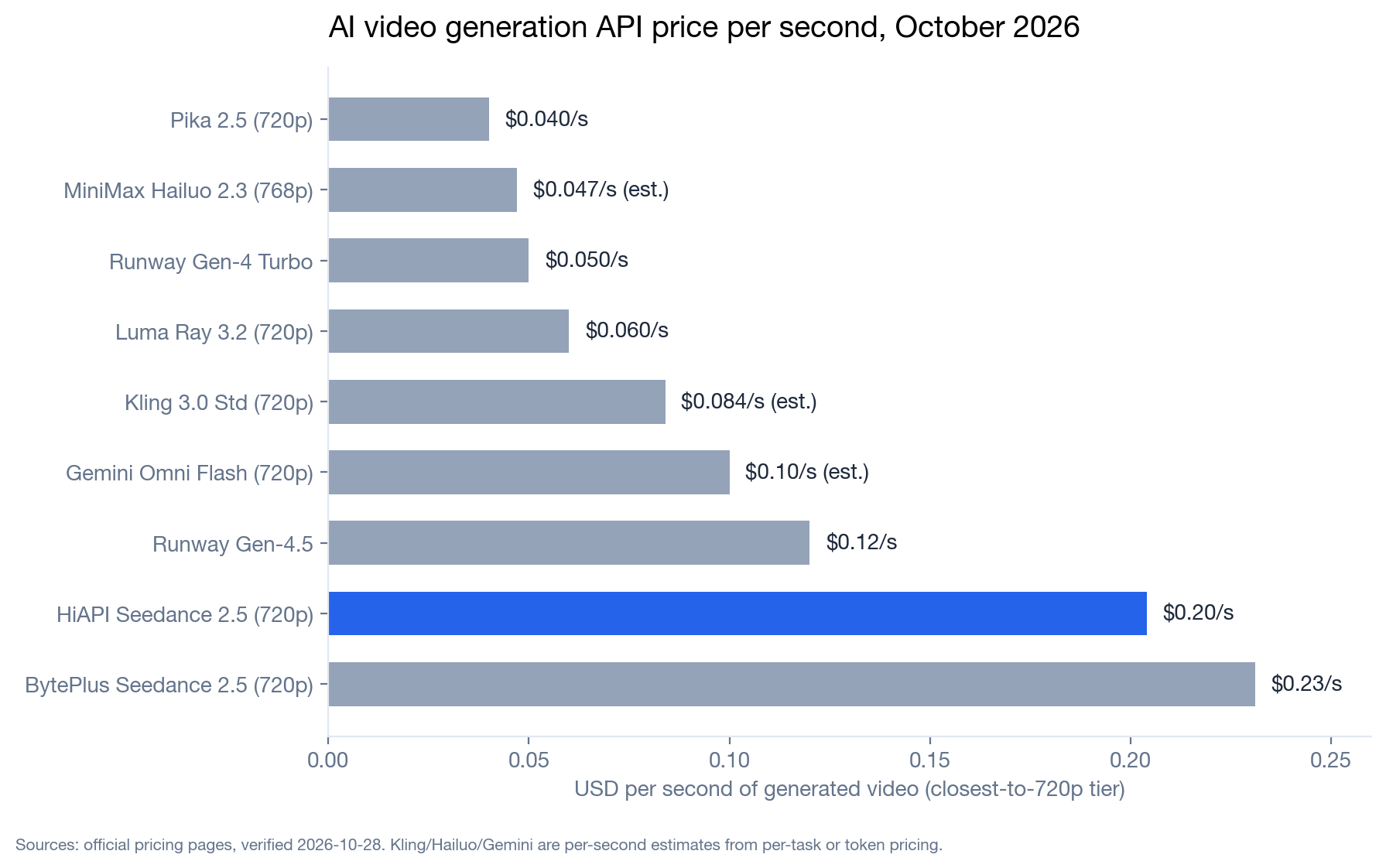
That makes this a good moment to re-survey the market. Below, every price was verified on 2026-10-28 and converted to one common unit: cost per second at 720p (or the closest available tier).
720p per-second price table
| Vendor / model | 720p $/s | Pricing basis | Notes |
|---|---|---|---|
| Pika 2.5 | $0.04 | Official, per second | Officially no free tier |
| MiniMax Hailuo 2.3 | ~$0.047 | Official, per job (768P/6s $0.28 converted) | 1080P priced separately |
| Runway gen4_turbo | $0.05 | Official credits (5 credits/s at $0.01 each) | — |
| Luma Ray3.2 | $0.06 | Official, per clip (720p 5s $0.30 converted) | 4x at 1080p; HDR x2 |
| Kling 3.0 Standard | ~$0.084 (no audio) | Third-party report, ~$0.126–0.168/s with audio | Exact official price not published; treat as estimate |
| Gemini Omni Flash | ~$0.10 | Official, per token (720p ≈5,792 tokens/s at $17.50/1M) | No free tier |
| Runway gen4.5 | $0.12 | Official credits (12 credits/s at $0.01 each) | — |
| HiAPI Seedance 2.5 (text-to-video) | $0.204 | Platform price (720p tier) | Image-to-video $0.204/s; reference-to-video from $0.1215/s (480p, $0.2715 at 720p) |
| Seedance 2.5 official | $0.231 | Official, per token (720p; audio x0.6 / mute x0.7 factors) | Same model, official price |
Two caveats. Kling 3.0's per-second rate comes from third-party reporting; the same model resold through Runway's API at $0.09/s without audio and $0.13/s with audio is consistent with that range, but a resale price is not an official price, so confirm before committing. Also, these models are not all at the same quality tier. This table answers the money question, not the image-quality question.
Short takes, vendor by vendor
Pika 2.5: $0.04/s is the cheapest per-second rate in the table ($0.02 at 480p, $0.06 at 1080p). The vendor explicitly states there is no free tier, so do not go looking for one in the app.
MiniMax Hailuo 2.3: Priced per job: $0.28 for 768P/6s and $0.56 for 10s, which converts to roughly $0.047/s. A Fast tier at $0.19 per 768P/6s cuts this further, and failed moderation does not cost you. Note the free allowance only covers the first five images of an image task; video has none.
Runway: gen4_turbo at $0.05/s and gen4.5 at $0.12/s, billed in credits ($0.01 each) at 5 and 12 credits per second respectively. The two tiers map cleanly to budget and quality. One warning: the one-time 125 credits given to consumer accounts do not transfer to API balance.
Luma Ray3.2: $0.06/s at 720p (a $0.30 5-second clip), but 1080p costs four times as much ($1.20/5s), and HDR multiplies the price by 2, HDR+EXR by 3. Its real differentiator is V2V: 15s and 20s outputs billed in 5-second blocks, the most mature option for restyling existing footage.
Kling 3.0 Standard: Third-party reporting puts 720p at ~$0.084/s without audio and ~$0.126–0.168/s with audio. The model's resale price through Runway's API ($0.09/$0.13) corroborates the magnitude, but Kling's official site publishes no public price list. Verify in the official console before you build a budget on it.
PixVerse V6: Credit-based (225 credits per $1), with silent video from $0.022/s at 360p to $0.080/s at 1080p, and a V6 Max tier at $0.027–0.124/s. The entry tier undercuts even Pika, but no free tier is listed, making it a fit for aggressive cost-cutting on muted clips.
Gemini Omni Flash: ~$0.10/s at 720p, and the most full-featured entry in this table. Audio (music, sound effects, dialogue) is generated by default, clips can be extended by +10s up to a 40s total, and resolution runs from 360p to upscaled 4K. No free tier.
Seedance 2.5: On HiAPI, text-to-video and image-to-video are both $0.204/s at 720p, and reference-to-video starts at $0.1215/s (480p; $0.2715/s at 720p), versus $0.231/s official at 720p for the same model. It is a 2.5-generation quality-tier model in the same price bracket as gen4.5, but supports up to 30 seconds, seven aspect ratios, and synchronized audio, and failed generations are not charged. To try it without writing any integration, open the Seedance 2.5 Text to Video model page or run a clip in the Playground.
How to choose, by scenario
Cheap bulk generation (short-form clips, batch testing): Pika 2.5 ($0.04/s) and MiniMax Hailuo 2.3 (~$0.047/s) lead, with Runway gen4_turbo at $0.05/s close behind. In volume scenarios you trade some quality for cost, so test in ascending price order.
Built-in audio: Fewer options than you would expect. Gemini Omni Flash generates audio by default and has the fullest spec sheet; Seedance 2.5 supports synchronized audio, and HiAPI's reference-to-video starts at $0.1215/s at 480p, one of the friendliest entry rates among audio-capable models.
Long clips: Gemini Omni Flash's 40-second total is the current public-API ceiling. Seedance 2.5 reaches 30 seconds. Beyond that, plan on generating segments and editing them together.
Video-to-video: Luma Ray3.2 is the most mature option with 15s/20s V2V billed in blocks. Seedance 2.5's reference-to-video route (from $0.1215/s at 480p), which migrates motion and pacing from a reference clip, is a credible alternative worth testing.
The free tier reality
Here is the short version: major video APIs essentially have no free tier.
Gemini Omni Flash has none. Pika explicitly has none. Luma's API has none. PixVerse lists none. MiniMax's free allowance applies only to image tasks, not video. The credits Runway hands out to consumer accounts do not carry over. Every consumer app free tier and web trial is a customer-acquisition tool for end users, sitting in a different ledger from API balance entirely.
So the right question is not "can I use it for free" but "what are the failure terms": MiniMax does not charge for failed moderation, Seedance 2.5 does not charge for failed generations. Those clauses are worth more than any phantom free quota.
FAQ
Can I still call Sora 2 or Veo 3.1 through an API?
No. The Sora 2 API was removed on 2026-09-24 with no official replacement, and the Veo 3.1 preview line was shut down on 2026-10-22, with Google pointing users to Gemini Omni Flash. Historical prices floating around for Veo 3.1 (roughly $0.10/s at 720p) are third-party records and no longer valid for procurement.
Why is Seedance 2.5 cheaper on HiAPI than the official price?
Same model, $0.204/s versus $0.231/s at 720p, a $0.027/s gap. Platforms price the same model differently, which is exactly why aggregation platforms exist. You can factor the gap into cost projections, but run real tasks on both before standardizing.
How do I compare per-credit, per-token, and per-job pricing?
Convert everything to $/second first. Every number in this article has already been converted (the basis is noted in the table). Do the same whenever you verify prices yourself; comparing credit prices directly will get the ranking wrong every time.
Is image generation pricing structured the same way?
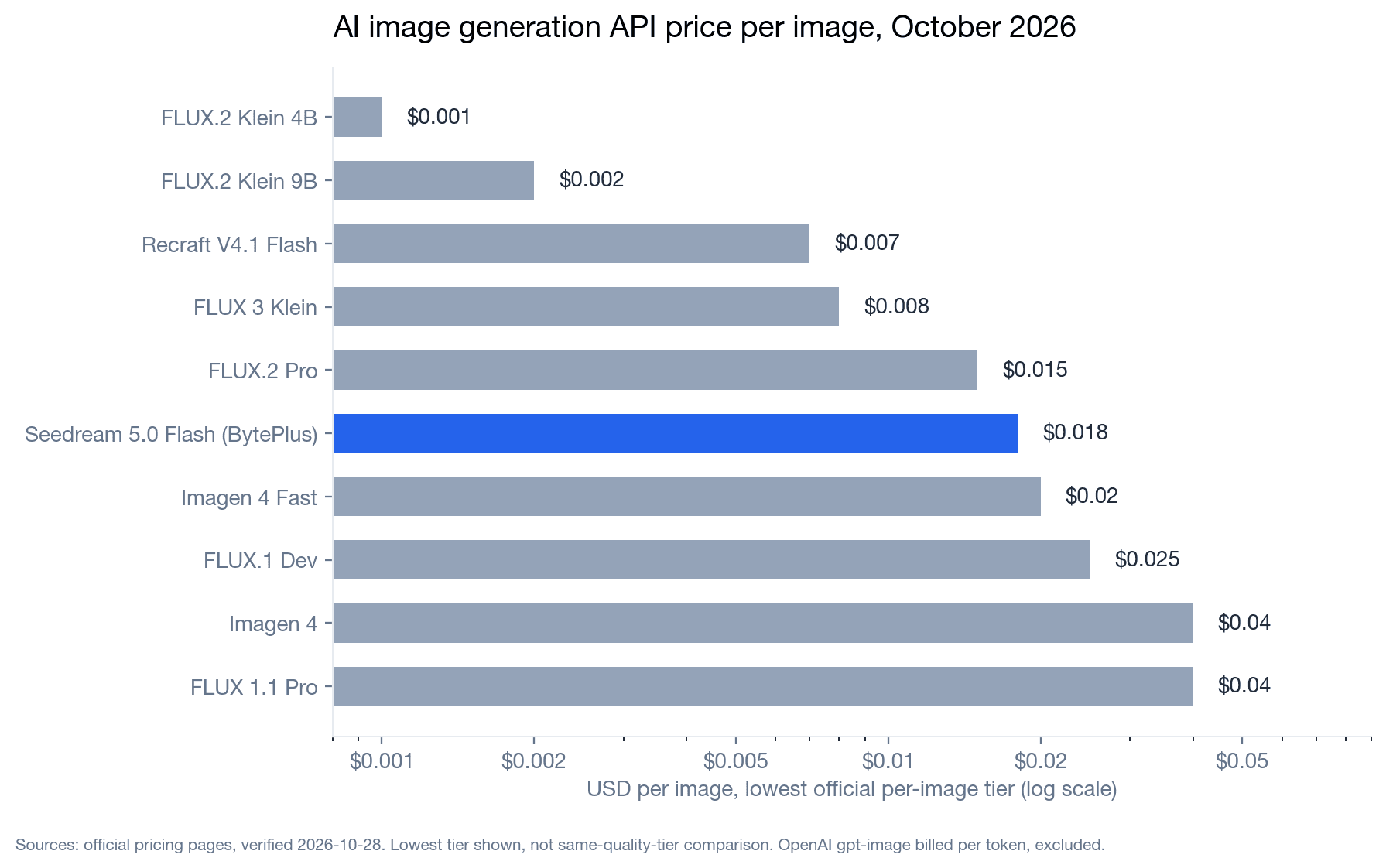
Same logic (compare per image, watch for token-based traps), very different landscape. We cover it in a separate article: AI image generation API pricing compared.
Key takeaways
The minimum viable workflow for choosing a video API is three steps: convert every candidate to $/second on one basis, eliminate the ones that fail your scenario (volume, audio, length, V2V), then run ten real clips on each finalist. As of October 2026, the budget tier starts at $0.04/s with Pika and MiniMax, and the quality tier offers built-in audio through Gemini Omni Flash and Seedance 2.5. To test any of these without writing a single line of integration code, open the HiAPI Playground.