The first question when picking an image generation API is always "what does one image cost." But the vendors make it messy: some charge per image, some per token, some split by resolution, and at least one popular name has no official API at all. This article puts the official prices we verified on October 28, 2026 into one table, then explains what the billing models and free tiers actually mean. For video, see the companion piece on AI video generation API pricing.
Per-Image Price Table (Each Vendor's Cheapest Tier)
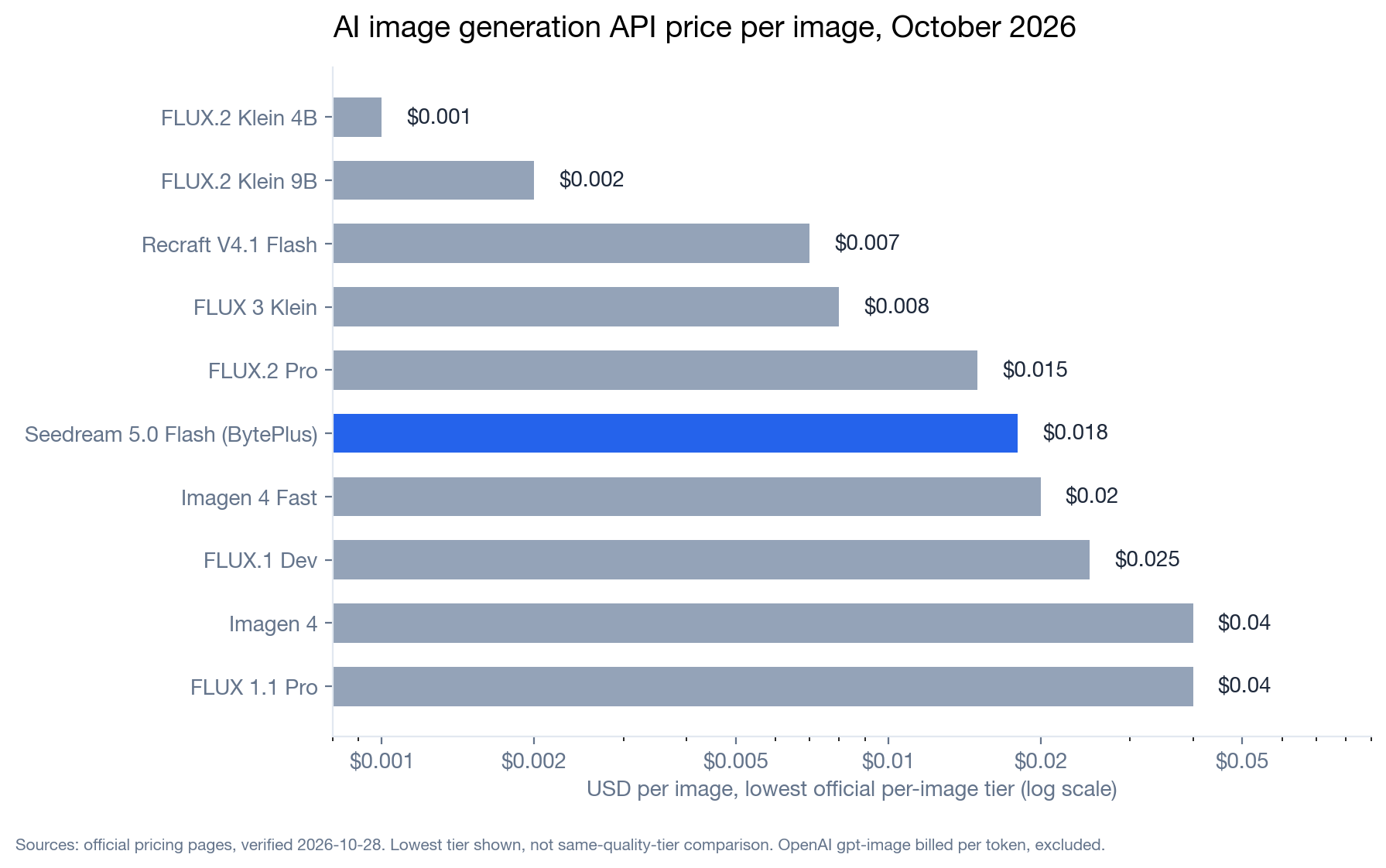
Everything that can be converted to per-image pricing, ascending:
| Model | Cheapest per image | Notes |
|---|---|---|
| FLUX.2 [klein] 4B | $0.001 | Official, per image |
| FLUX.2 [klein] 9B | $0.002 | Official, per image |
| Recraft V4.1 Flash | $0.007 | Raster, $1 = 1000 units |
| FLUX 3 Klein | $0.008 | Official, per image |
| FLUX.2 [pro] | $0.015 | Official, per image |
| Seedream 5.0 Flash (BytePlus official) | $0.018 | Official, per image |
| Imagen 4 Fast | $0.02 | Vertex AI, per image |
| FLUX.1 [dev] | $0.025 | Official, per image |
| Ideogram V3 Flash | ~$0.03 | Third-party secondary source; official price behind login |
| Nano Banana 2.1 (1K) | $0.0336 | Official, per image |
| FLUX 1.1 [pro] / Imagen 4 | $0.04 | Official, per image |
| Seedream 5.0 Pro (≤1.5K) | $0.045 | Official, per image |
| Imagen 4 Ultra | $0.06 | Official, per image |
| Nano Banana 2.1 (4K) | $0.113 | Official, per image |
| Nano Banana Pro (1K/2K) | $0.134 | Official, per image |
| Nano Banana Pro (4K) | $0.24 | Official, per image |
Two caveats before reading anything into it. First, these are each vendor's cheapest tier, not a same-quality comparison: the $0.001 klein 4B and the $0.24 Nano Banana Pro 4K are not built for the same job. Second, OpenAI is missing from the table because gpt-image no longer has per-image pricing — it bills per token, which gets its own section below.
Vendor Notes
FLUX family (Black Forest Labs). The widest price band, $0.001 to $0.06. Entry is FLUX.2 [klein] 4B at $0.001/image; quality tiers are FLUX 1.1 [pro] at $0.04 and Ultra at $0.06, with FLUX.2 [pro]/[max]/[flex] at $0.015/$0.03/$0.05 — all pay-as-you-go, no subscription. FLUX 3 Image is $0.041 with a separate megapixel card (first MP $0.07). One nuance: FLUX.1 [schnell] is open-weights and the vendor publishes no per-image API price for it. FLUX Schnell on HiAPI runs $0.005/image, hard to beat for batch drafts.
Recraft. V4.1 Flash raster at $0.007/image, standard V4.1 at $0.035, vector at $0.08. Billing is prepaid units ($1 = 1000) that never expire — good for spiky usage.
Imagen (Google). On Vertex AI it is per image: 4 Fast $0.02, 4 $0.04, Ultra $0.06. The Gemini API side no longer sells Imagen directly — it pushes Nano Banana instead, so pick your Google route before integrating.
Nano Banana (Google Gemini API). Version 2.1 splits by resolution: 1K $0.0336, 2K $0.0504, 4K $0.113. Pro is steeper: $0.134 for 1K/2K, $0.24 for 4K. No free tier — if you need 4K, this is the expensive end of the table.
Seedream (BytePlus). 5.0 Flash at $0.018/image; Pro at $0.045 up to 1.5K and $0.09 above. The free side is generous: input images are free except on Pro (first one free there), and failed moderation reviews are not charged. One detail worth knowing: the same model can carry different prices on different platforms — BytePlus lists Seedream 5.0 Flash at $0.018/image, while Seedream 5.0 Flash on HiAPI is priced at $0.025/image. Compare before you commit; the difference buys one-key integration.
Ideogram (prices unverified). V3 Flash/Default/Quality at roughly $0.03/$0.06/$0.09, 4.0 at roughly $0.03/$0.06/$0.10. Caution: these come from a third-party secondary source (eesel.ai), and official prices sit behind a logged-in console — verify there first. Ideogram's strength is in-image text and logos; if that is worth the price to you, confirm it at the source.
OpenAI gpt-image: How to Estimate Token Billing
For gpt-image-2/2.5, the pricing is $8 per 1M image input tokens, $30 per 1M image output tokens, $5 per 1M text input tokens, with batch at half price. The lighter gpt-image-1-mini is $2.50 input / $8 output per 1M. OpenAI no longer publishes per-image pricing, so there is no official per-image answer — only estimates.
The math itself is simple: cost per image = (text input tokens × $5 + image input tokens × $8 + image output tokens × $30) ÷ 1M. Output tokens cost 6× text input and nearly 4× image input, so higher resolutions and more edit iterations weigh on the bill fast. Actual token counts depend on your prompt length and output resolution, so run your typical use case through OpenAI's official calculator. To be clear: that result is an estimate, not an official per-image price. For batch workloads, the batch endpoint at half price makes a real difference.
Midjourney: No Official API, and That Matters
Multiple third-party sources agree: Midjourney exists only as a web app and a Discord bot. There is no official API. Every "MJ API" you can buy is a third-party wrapper routing your prompts through someone's consumer account, violating the terms of service. Those accounts get banned, and whatever you built on them goes down too. Keep wrappers out of production.
The subscription tiers, roughly $10/30/60/120 per month (third-party reports), are consumer plans — not API pricing. If there is one place where "subscription price ≠ API price" matters most, it is here.
The Free Tier Reality
"Free" in image APIs usually means a limited quota, not a free lunch:
- MiniMax: first 5 images per task free (H3 tasks) — fine for a trial, not for volume
- BytePlus: first input image free on Seedream 5.0 Pro (input images free on non-Pro tiers), and no charge when moderation fails
- Ideogram: the 10 slow credits per week belong to the consumer web app, not the API
The conclusion: sustained volume is paid, per image. The genuinely zero-cost way to vet a model is to run a few of your own prompts in a playground first.
How to Choose, by Scenario
- Batch drafts and asset volume, price-sensitive → the FLUX family. FLUX Schnell at $0.005/image on HiAPI means 10,000 images for $50
- Chinese prompts at low cost → Z-Image at $0.008/image on HiAPI
- E-commerce product shots, photorealistic portraits → Seedream 5.0 Flash ($0.025/image on HiAPI) or Imagen 4 Fast at $0.02 official
- In-image text, logos, posters → Ideogram (verify pricing in the official console) or GPT Image 2
- Multi-round editing with character/product consistency → Nano Banana 2.1
- Vector design output → Recraft vector at $0.08/image
- You already live on the OpenAI stack → gpt-image, accepting per-token uncertainty and routing batches through the half-price endpoint
Instead of opening accounts at every vendor and juggling keys, route all of these through a single key on the HiAPI model marketplace, with pricing and a playground on each model page.
FAQ
Which image generation API is the cheapest? The lowest official per-image price in the table is FLUX.2 [klein] 4B at $0.001, but it is a small entry-tier model — do not benchmark it against flagship tiers. On the integration side, FLUX Schnell at $0.005/image on HiAPI is the cheapest usable starting point.
What does OpenAI gpt-image actually cost per image? Officially, only token pricing: $30/1M image output, $8/1M image input, $5/1M text input, batch at half price. There is no official per-image number. Per-image cost depends on resolution and prompt length — estimate your typical case with the official calculator (an estimate, not an official price).
Does Midjourney have an API? No official API exists — only the web app and Discord. Third-party "MJ API" services violate the terms of service and carry account-ban risk. The ~$10/month-and-up subscriptions (third-party reports) are consumer plans, not API pricing.
Is there a genuinely free image generation API? There are limited quotas: MiniMax's first 5 images per task, BytePlus's free first input image, no charge on failed moderation. Sustained volume is paid per image; a playground trial beats chasing free credits.
Key Takeaway
A two-orders-of-magnitude price spread comes from mismatched quality tiers and different billing models, not from one vendor being "240× better." The right order of operations: fix your scenario first, then compare prices within that scenario's candidates — never entry tier against flagship. Before integrating, do two things: confirm the billing basis (per image or per token), and run a few of your own prompts to see the output. Video pricing plays by different rules; see the companion piece on AI video generation API pricing.