Kimi K3.1 Pro and Claude Opus 5.5 cost almost exactly the same at the API level — $2 input / $10 output per 1M tokens for Kimi K3.1 Pro, versus $2.02 / $10.08 for Claude Opus 5.5 on hiapi as of October 2026. So this is not a "cheaper alternative" story. It is a story about two models with the same price tag and very different strengths.
The short version: Kimi K3.1 Pro, released by Moonshot AI on October 23, 2026, is a post-training upgrade of K3 that jumps to #4 on the Artificial Analysis Intelligence Index, nearly matches Opus 5.5 on agentic coding, roughly halves its hallucination rate, and brings a 1M-token context window plus a promise of full open weights. Opus 5.5, meanwhile, still dominates deep scientific reasoning and sits one rank above it overall. The consensus across five or more third-party sources as of October 2026: Kimi K3.1 Pro wins in specific spots, but it has not overtaken Opus 5.5 across the board.
Here is how the comparison breaks down by scenario, and how to choose between them.
Where Kimi K3.1 Pro comes from: the K3 to K3.1 jump
K3.1 Pro is the first model in the K3.1 series, and architecturally it is the same model as K3: a 2.8T-parameter mixture-of-experts with 104B active parameters, a 1M-token context window, and text plus image input (no audio or video). What changed is the post-training.
That single change moved the needle dramatically:
- Agentic coding jumped: Terminal-Bench went from 13% on K3 to 67% on K3.1 Pro — the highest Artificial Analysis has ever measured on that benchmark.
- Hallucination rate dropped from 23.4% to 8.3%, a nearly three-fold reduction.
- Financial research capability improved substantially, per Moonshot AI's own reporting.
- Official API price dropped 33%, from $3/$15 per 1M tokens for K3 to $2/$10 for K3.1 Pro.
- Speed roughly doubled, though as of October 2026 it still sits in the slower tier across sources at 27–80 tokens per second.
It also landed hard in the Chinese developer community — launch-day demand reportedly burned through quotas within minutes. And Moonshot AI has committed to releasing the complete weights by November 4, 2026, which would make it the highest-scoring open-weights model on the Artificial Analysis index.
One caveat before the numbers: the K3.1 Pro versus Opus 5.5 figures below largely come from vendor self-tests. Kimi's numbers were typically run at max effort while Opus 5.5's defaults to medium, so the comparison is not perfectly apples-to-apples. Treat every benchmark here as directional.
Coding: a genuine near-tie, with Kimi ahead on marathon tasks
This is where the fight is closest, and where Kimi K3.1 Pro's agentic gains show most clearly.
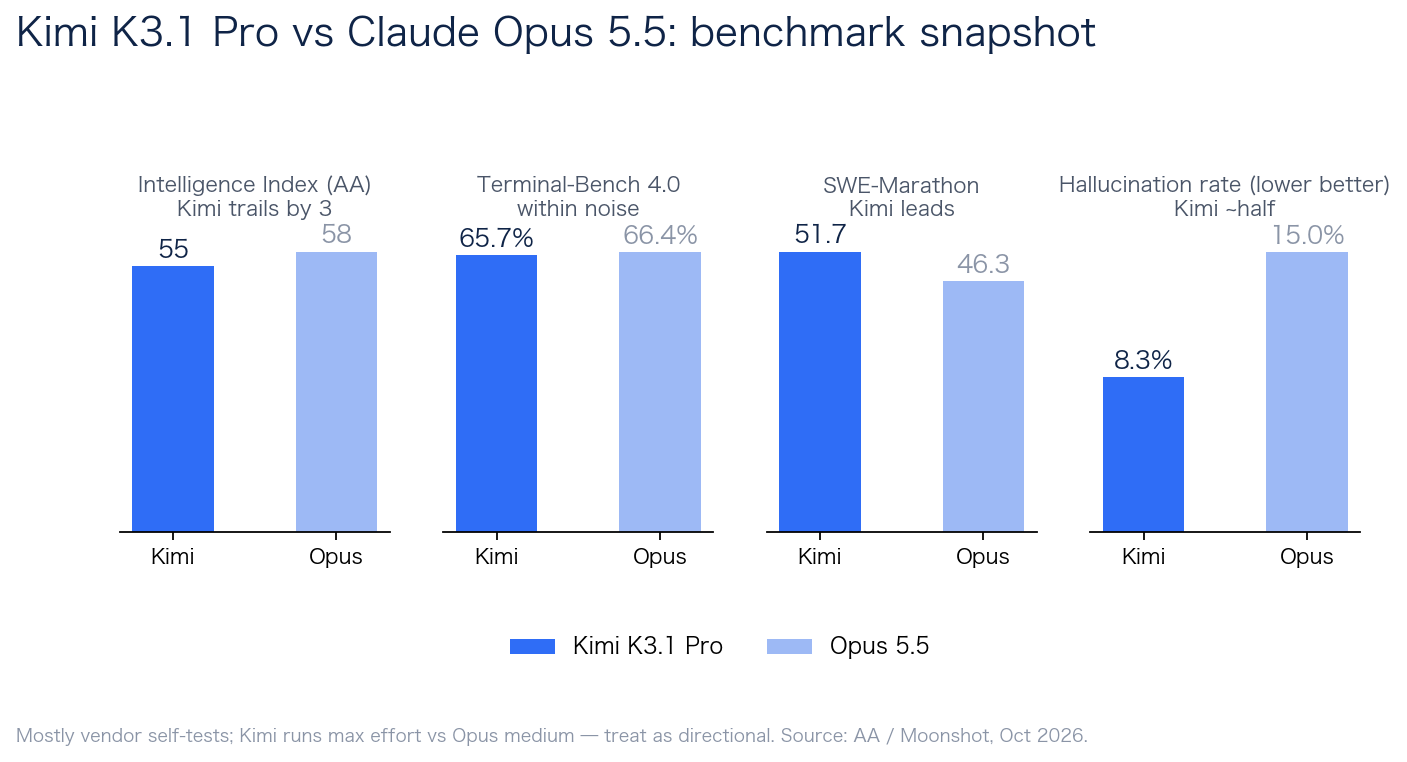
On Terminal-Bench 4.0, the two models are within noise of each other: 65.7 for Kimi K3.1 Pro versus 66.4 for Claude Opus 5.5. On SWE-Marathon, a harder, longer-horizon software engineering benchmark, Kimi actually leads: 51.7 versus 46.3. On the agentic-specific GDPval-AA sub-ranking, Kimi sits at #3 with 1,846 Elo.
For day-to-day development work, the practical read is this: if your workload is long agentic sessions — multi-step refactoring, autonomous bug fixing, tasks that run for hours — Kimi K3.1 Pro's training focus shows up exactly where Opus 5.5 has historically been strongest. If your workload is more interactive, single-shot code generation, the two are effectively interchangeable on benchmarks.
The catch is effort settings. A large share of Kimi's coding numbers were produced at max effort, while Opus 5.5's published figures default to medium. A max-effort Opus run would likely close some of these gaps. If coding quality is the decision driver for you, run both on ten real tasks from your own repo before trusting any benchmark — including this one.
Deep reasoning: Opus 5.5 still dominates
On hard scientific reasoning, the picture is not close. Across third-party comparisons as of October 2026, Claude Opus 5.5 beats Kimi K3.1 Pro by roughly 25 points on deep science reasoning tasks. That is the single widest gap in this entire comparison.
The overall index reflects the same ordering: Opus 5.5 scores 58 on the Artificial Analysis Intelligence Index versus Kimi's 55, with Claude Sonnet 5.5 and Muse Wonder Full tied at 56 in between. Kimi's #4 is a remarkable debut — up from 44 for K3 — but it is still one step behind.
What does that mean in practice? If your work is research-grade analysis, complex multi-hop logical deduction, or science-heavy question answering, Opus 5.5 remains the safer default. Kimi K3.1 Pro is competitive, not dominant, in this scenario — and it would be dishonest to claim otherwise.
Hallucination rate: Kimi's clearest win
If coding is a tie and reasoning favors Opus, hallucination is where Kimi K3.1 Pro delivers its most decisive advantage: 8.3% versus 15.0% — roughly half the rate of Claude Opus 5.5 in third-party testing.
Given that K3 hallucinated at 23.4%, dropping to 8.3% in one post-training revision is the single most impressive line item in the K3 to K3.1 upgrade. It also happened to be the most-cited weakness of the previous generation.
For anyone building RAG pipelines, document summarization, financial analysis, or any application where a confident wrong answer is worse than no answer, this matters more than a few index points. A model that invents facts half as often changes how much verification infrastructure you need around it.
Long context: 1M tokens changes the conversation
Claude Opus 5.5 ships with a large context window, but Kimi K3.1 Pro goes further with a native 1M-token context, accepting both text and image input. Combined with a cache-hit price of $0.20 per 1M tokens, that opens workloads that are awkward or expensive on Opus 5.5:
- Whole-codebase analysis and repository-level refactoring in a single pass
- Long legal or financial document review with full-text grounding
- Multi-document research synthesis without chunking and stitching
The caveat is speed. At 27–80 tokens per second across sources as of October 2026, Kimi K3.1 Pro sits in the slower tier. Feeding it a million tokens means waiting, and the cost of a full-context call adds up. Moonshot AI offers a Highspeed variant at $4/$20 per 1M tokens that runs 2–3x faster, which is worth pricing into any high-throughput design.
Price and speed: same price, different speed tiers
As of October 2026, the official API pricing is essentially identical at the headline level:
| Input ($/1M) | Output ($/1M) | Cache hit ($/1M) | |
|---|---|---|---|
| Kimi K3.1 Pro | $2.00 | $10.00 | $0.20 |
| Kimi K3.1 Pro Highspeed | $4.00 | $20.00 | — |
| Claude Opus 5.5 (on hiapi) | $2.02 | $10.08 | $0.10 |
[$2.1548/$11.2714(截至 2026-10): platform pricing for kimi-k3.1-pro on hiapi, fill from /api/pricing after launch; until then kimi-k3 is available on hiapi to test the workflow]
Two things stand out. First, this comparison is unusual in that price is a non-factor — the decision has to be made on capability alone. Second, Opus 5.5's cache-read price is half of Kimi's ($0.10 vs $0.20), which matters if your workload re-reads the same long context repeatedly; Kimi's cheaper full-context access and Opus's cheaper repeated access pull in opposite directions depending on your caching pattern.
On speed, Opus 5.5 is simply the faster-feeling model in this pairing. Kimi K3.1 Pro roughly doubled K3's speed but remains in the slower tier, and its cost per task on Artificial Analysis sits at $1.98 — the same as K3, meaning the speed gain did not come at an efficiency cost, but did not improve it either.
If you are already running Claude Code or similar agent tooling, our walkthrough on setting up Claude Code with a hiapi API key covers how to point agentic coding tools at either model through one key.
Which one should you pick?
Pick Kimi K3.1 Pro if:
- Your core workload is long agentic coding sessions and autonomous engineering tasks, where its SWE-Marathon lead and Terminal-Bench gains are most visible.
- You run RAG, document review, or fact-sensitive pipelines where a 8.3% hallucination rate versus 15.0% changes your verification overhead.
- You need 1M-token context for whole-repo or multi-document work in a single pass.
- Open weights matter to you — full weights are promised by November 4, 2026, which matters for self-hosting and auditability.
Pick Claude Opus 5.5 if:
- Your work is research-grade scientific reasoning — this remains Opus 5.5's strongest card, by roughly 25 points.
- You need the top overall model on the Artificial Analysis Intelligence Index (58 vs 55) and want the most proven option.
- Latency matters: Opus 5.5 is the faster model, and its $0.10 cache-read price favors workloads that repeatedly re-read the same context.
Consider running both. At identical per-token pricing, splitting traffic by scenario costs nothing extra at the margin — Kimi for agentic coding and long-context fact work, Opus for deep reasoning — and hedges against either model's weak spots. You can explore both on their model pages, starting with Claude Opus 5.5.
FAQ
Is Kimi K3.1 Pro better than Claude Opus 5.5?
No — not overall, as of October 2026. The honest picture from five or more third-party sources is that Kimi K3.1 Pro wins in specific areas (hallucination rate, SWE-Marathon, agentic gains) while Claude Opus 5.5 keeps clear leads in deep scientific reasoning (by roughly 25 points) and on the overall Artificial Analysis Intelligence Index (58 vs 55). Many comparison numbers are also vendor self-tests with unequal effort settings, which further argues for testing on your own tasks.
How much does the Kimi K3.1 Pro API cost?
The official API price is $2 per 1M input tokens and $10 per 1M output tokens, with cache hits at $0.20 per 1M tokens. A Highspeed variant runs 2–3x faster at $4/$20 per 1M tokens. [$2.1548/$11.2714(截至 2026-10): platform pricing, fill from /api/pricing after launch]
What is Kimi K3.1 Pro's context window?
1M tokens, with support for both text and image input. It does not accept audio or video input. The long context pairs well with a cache-hit price of $0.20 per 1M tokens for workloads that process very large documents or whole codebases.
Is Kimi K3.1 Pro open source?
Moonshot AI has committed to releasing the complete weights by November 4, 2026. Once released, it is expected to be the highest-scoring open-weights model on the Artificial Analysis Intelligence Index.
Which is better for coding, Kimi K3.1 Pro or Claude Opus 5.5?
On benchmarks they are nearly tied — Terminal-Bench 4.0 scores 65.7 versus 66.4 — with Kimi K3.1 Pro ahead on the longer-horizon SWE-Marathon benchmark (51.7 vs 46.3). Most of these numbers come from vendor self-tests with different effort settings, so the most reliable answer comes from running both on real tasks from your own codebase.
Is Kimi K3.1 Pro slow?
It is in the slower tier as of October 2026: 27–80 tokens per second depending on the source. That is roughly twice as fast as K3 was, but still slower than Claude Opus 5.5 in practice. If speed is critical, the Highspeed variant at $4/$20 per 1M tokens runs 2–3x faster.
Key takeaways
- Price is a non-factor at $2/$10 per 1M tokens — pick by workload, not cost. Agentic coding and long-context fact-heavy work lean Kimi K3.1 Pro; deep scientific reasoning leans Claude Opus 5.5.
- The coding gap is small enough that your own repo is the real benchmark. Vendor self-tests with unequal effort settings mean both models' published numbers overstate their case somewhat.
- Hallucination rate (8.3% vs 15.0%) and 1M context are Kimi K3.1 Pro's most decision-relevant advantages — especially for RAG and document pipelines.
- All figures in this article are as of October 2026, drawn largely from vendor self-tests and third-party benchmarks; re-verify pricing and rankings after the model's full release.