Blog
AI Image & Video API Guides
Hands-on model tests, production tutorials, prompt techniques, and current API pricing for generative media teams.

Fal.ai API Alternative: Keys, Docs, Pricing, and Migration Notes
fal.ai is a developer-first generative-media platform with serverless GPU and pay-per-use billing; if it fits your stack, it is a solid choice. HiAPI is a fair alternative when you want one unified API across image and video models, a single key, and pay-as-you-go pricing. HiAPI generation uses the unified async /v1/tasks API; existing clients must map model names, input fields, and result handling to that task contract. Migration means getting a HiAPI key, submitting a task, then polling or receiving a callback before downloading the result. Pricing on both is output-based; compare the model and read HiAPI's live pricing instead of relying on frozen figures.

Seedance 2.0 API Guide: Mini, Fast, Standard and the ext Route
Four ways to call it: Mini, Fast, standard, and standard on the ext route. 720p per second: Mini $0.0586, ext $0.134, Fast $0.1772, standard $0.293. Sound is on by default at no extra cost; clips run 4–15 s.

GPT Image 2 Image-to-Image API Guide
Image-to-image transforms an asset you already own — background swap, restyle, scene change — instead of generating from scratch. On hiapi, gpt-image-2-image-to-image is $0 per call; iterate for free. The only new parameter is input_urls: the source image(s) to transform. Anchor the subject with 'keep the product shape and color unchanged' so the model restyles the scene, not the product.

Best AI Image Generation APIs in 2026
There is no single best image API — the right model depends on the job; one integration should give you all of them. hiapi's image roster spans more than 100× in price, from flux-schnell ($0.005) to gpt-image-2.5-flare@pro at max quality ($0.7143). Same-prompt test: gpt-image-2 and nano-banana-2 render on-image text cleanly; FLUX 1.1 Pro is weaker on dense text. gpt-image-2 ($0.03) is the best price-to-instruction-following default.

ChatGPT Images 2.0 vs gpt-image-2: Which One Should Developers Use?
ChatGPT Images 2.0 (consumer) and gpt-image-2 (developer API) draw from the same model family but solve different problems. OpenAI's direct API is token-billed, so the same 1024×1024 canvas can run ~35× more expensive at high vs low quality. hiapi resells gpt-image-2 at a flat $0.03/call at 1K, with gpt-image-2-pro at $0.35 for the polished hero-shot tier. Three decision rules: explore in ChatGPT, ship in the API, escalate to pro only where polish is the product.
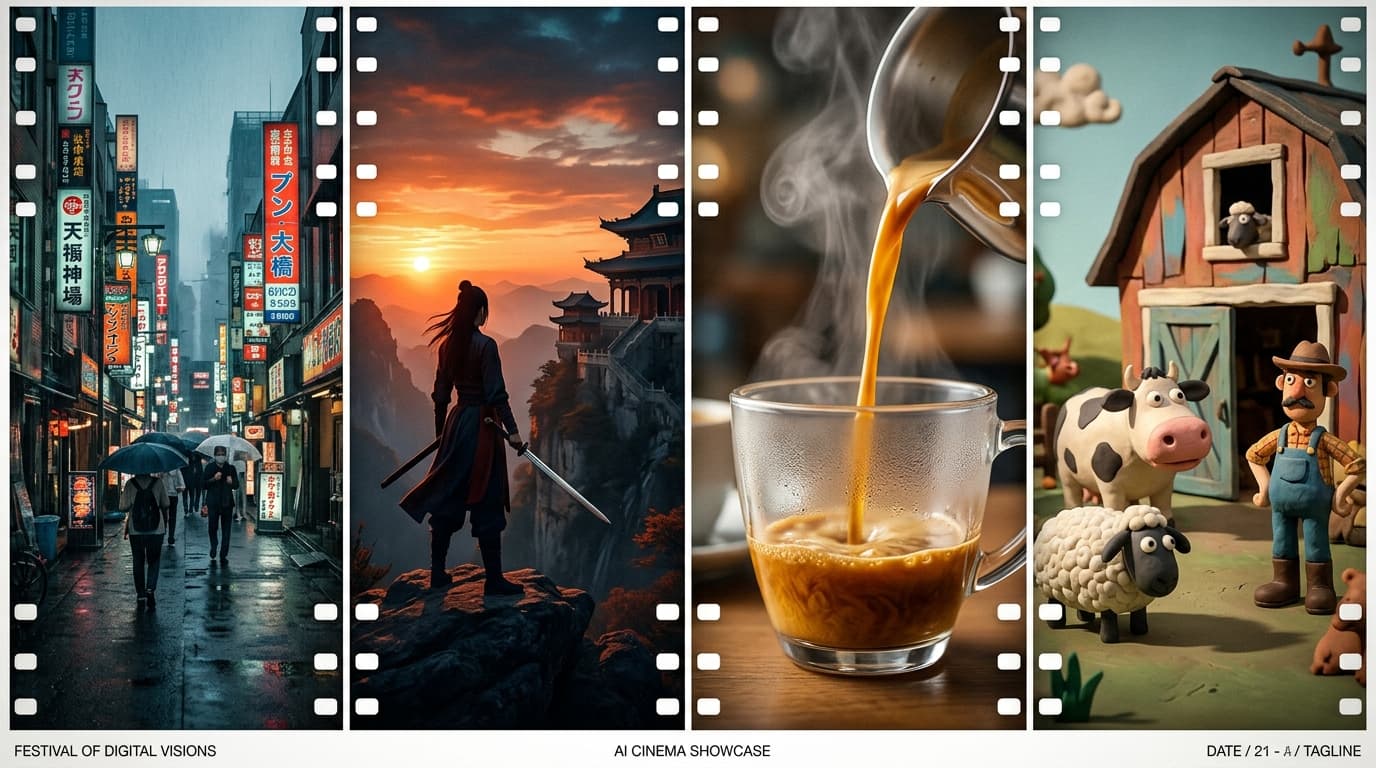
Best AI Video Generation API in 2026: Comparing hiapi's Four Video Models
hiapi ships four video generation models spanning about 4.4× in per-second cost at 1080p: wan2.7-video/text-to-video / wan2.7-i2v at $0.167/sec, happyhorse-1-0 at $0.288/sec, and seedance-2-0 at $0.729/sec. wan2.7 (t2v and i2v) is the price floor for HD output on the platform — use it as your default unless your project specifically needs cinematic stylization or premium polish. seedance-2-0 is the only model that handles both text-to-video and image-to-video in one integration, plus offers a cheap 480p tier ($0.136/sec) that's great for storyboarding before HD render. Once you factor in real acceptance rates (1 in 4 takes kept), the cost gap between cheap and premium widens fast — making model choice a real unit-economics decision, not just an aesthetics one.

Adding AI Image Generation to a Next.js App With the hiapi API
Image generation takes 60–120 seconds — too long for a single client request, so the app must split the work across a route handler that creates a task and a polling endpoint that surfaces progress without holding a serverless invocation. Calling hiapi directly from a React component leaks the API key to the browser. A Next.js route handler keeps the key on the server and gives you one auditable place to rate-limit and validate prompts. Output URLs returned by hiapi are signed and short-lived. Apps that store them directly will serve 404s on refresh — mirror every successful result to R2 (or S3 / Supabase Storage) before persisting. Cumulative Layout Shift on AI-image apps is fixed by reserving the result container's aspect ratio with CSS and matching it to the ratio sent to hiapi.

Consistent Characters with Nano-Banana on hiapi: A Working Workflow for Storyboards and E-Commerce
Three nano-banana models on hiapi all tagged for character consistency: nano-banana ($0.05 flat), nano-banana-2 ($0.036 / $0.057 / $0.086 across 1K/2K/4K — 2K costs more than 1K), and nano-banana-pro ($0.057 at 1K/2K, $0.10 at 4K). The technique is a character bible — a dense, repeatable, deterministic prompt prefix that anchors face geometry, skin/hair markers, wardrobe, and vibe across all renders. No reference image, no fine-tune, no LoRA. Storyboard demo: one engineer character ('Mira') across cover, model sheet, warm-tungsten workshop, and cold-overcast rooftop. Same beanie, same toolbelt, same beauty mark stays on the right cheek through both scenes. E-commerce demo: one fashion model ('Aria') in three full-body look-book shots — frontal hero, three-quarter angle, then a wardrobe swap to a camel double-breasted overcoat. Face, hair parting, beauty mark, and gold studs all hold across renders. Flat nano-banana rejects the resolution field with a 400 — only set it for Pro and -2. Output URLs have an expireAt; download bytes immediately rather than hot-linking. Current estimated budget for all 8 images in the article: $0.41 (7 × $0.05 nano-banana + 1 × $0.057 nano-banana-pro hero).

hiapi Image and Video Generation APIs: The Complete Platform Guide
hiapi is an image and video generation API gateway: one Bearer-auth endpoint fronts FLUX 1.1 Pro, nano-banana, GPT-Image-2, Qwen-Image, Wan2.7, Seedance, and HappyHorse. Pricing is per finished task, not per token — $0.02 for gpt-image-2 beta, $0.05 for nano-banana or flux-1.1-pro, $0.729 per second for 1080p Seedance footage. No token billing, no surge. All generation runs through the async POST /v1/tasks endpoint. Same shape for text-to-image, image-to-image, text-to-video, image-to-video. Most image models accept input.prompt + input.aspect_ratio. qwen-image-2.0 uses a DashScope-style nested schema with literal pixel sizes — keep a model→payload adapter map. Four sample images in this post — cover illustration, photoreal portrait, CJK calligraphy signboard, layout poster — have a current estimated budget through hiapi of $0.172.

FLUX 1.1 Pro on hiapi: Capabilities, Pricing, and a Working Code Example
FLUX 1.1 Pro is on hiapi at $0.05 per image, flat across aspect ratios — no resolution multiplier. It is served on the async /v1/tasks endpoint, not /v1/chat/completions; use `aspect_ratio` not `size`. Photoreal portraits, product flat-lays, and short headline text render reliably; unprompted text on objects is still hallucinated. Older FLUX.1 Dev and the original FLUX Pro are not on hiapi — the catalogue carries only the 1.1 Pro flagship.
Build with the models you just read about.
Compare image, video, and audio models, then use the same API workflow in production.